Free Speech

Reproductive Freedom

It is almost certainly no accident that freedom of speech is one of the very first freedoms listed in the Bill of Rights: “Congress shall make no law…abridging the freedom of speech, or of the press, or of the people peaceably to assemble, and to petition the Government for a redress of grievances.” The Constitution’s framers believed that freedom of inquiry and liberty of expression were the hallmarks of a democratic society.

The First Amendment exists precisely to protect all forms of expression, from political dissent to even the most offensive and controversial speech, from government suppression. The best way to counter obnoxious speech is with more speech, not censorship.

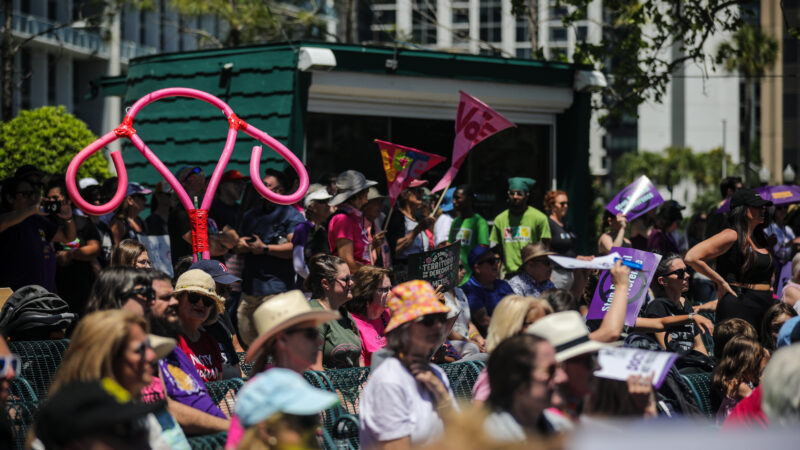
From defending the speech rights of protesters during events like the 2003 FTAA ministerial meetings in Miami and the 2012 Republican National Convention in Tampa, to ensuring that groups have the right to express themselves no matter what the content of their speech, the ACLU of Florida has been instrumental in challenging government efforts to silence protest groups and stifle freedom of expression.

The Latest
Press Release
ACLU of Florida Press Graphic

Federal Court Sanctions Florida Wildlife Official for False Statement and Law Firm for Vexatious Litigation in Case Challenging Employee’s Dismissal Over Charlie Kirk Social Media Post

Issue Areas: Free Speech
Court Cases: Brown v. Young
Press Release
ACLU of Florida Press Graphic

ACLU of Florida Sues Key West for Violating Residents’ Right to Protest the Removal of Duval Street’s Rainbow Crosswalks

Lawsuit argues the City selectively enforced its ordinances against a couple who painted their white fence in rainbow colors in support of the LGBTQ+ community
Issue Areas: Free Speech
News & Commentary
ACLU

What Dr. King’s Work in Florida Demands of Us Now

Florida on the Front Lines of Justice
Press Release
ACLU of Florida Press Graphic

State Employee Sues Eastern Florida State College Board of Trustees for Retaliatory Firing Over Protected Speech

Issue Areas: Free Speech
Court Case
June 11, 2026

Save the Garden v. City of Clearwater

This case challenges the City of Clearwater’s rejection of thousands of citizen initiative petition signatures in violation of the law. The citizen-led initiative petition “Save the Garden” collected over 8,000 signatures through an all-volunteer effort to put a measure on the Clearwater ballot to require voter approval before the city transfers public rights-of-way in the downtown. The city rejected thousands of valid petitions, contrary to the rules laid out in the City Charter. The city also failed to specify the reasons why it invalidated signatures as required, and enforced a rule limiting who can lead initiative efforts, in violation of the First Amendment.
Court Case
May 12, 2026

Cody v. Village of Palmetto Bay

This case challenges the Village of Palmetto Bay’s retaliation against an elected councilmember for his protected political speech. After Charlie Kirk’s death, Palmetto Bay Councilmember Steve Cody posted political satire critical of Kirk’s views on gun rights. In response, the Village Council removed Cody from a committee and rescinded related representative roles—despite acknowledging that Cody’s comments were protected by the First Amendment.
Court Case
April 7, 2026

Santos v. Howse

Erika Santos joined the public debate over what legacy Charlie Kirk was leaving behind in the aftermath of his public killing on September 10, 2025. In retaliation for her criticisms, Eastern Florida State College fired the grant accountant after a perfunctory “investigation”. This is the second case we have brought to combat the government’s efforts to expand its censorship power based on reactions to Kirk’s death (the first is Brown v. Young).
Court Case
May 22, 2025

Netchoice v. Moody

A 2021 Florida law generally prohibits “social media platforms” from censoring posts by or about political candidates and “journalistic enterprises.” It specifically penalizes any content moderation practices the law classifies as censorship, deplatforming, or shadowbanning of both political candidates and “journalistic enterprises.” Under the guise of “prohibiting censorship,” these laws seek to replace the private entities’ editorial voice with preferences dictated by the government. The ACLU’s position is that the government’s desire to have private speakers distribute more of any viewpoint is not a permissible basis for regulating the editorial decisions of private platforms. Choosing what not to publish and how to prioritize what is published is protected expression. On the very largest platforms, free expression values are best served if companies choose to preserve as much political speech as possible, including the speech of public figures. But, regardless of what platforms ought to permit as a matter of corporate policy, the government can’t constitutionally mandate what they ultimately choose. We filed amicus briefs in the district court (which granted a preliminary injunction on June 30, 2021), in the Eleventh Circuit (which, on May 23, 2022, affirmed in part and reversed in part the injunction), and the Supreme Court, which, on July 1, 2024, asked the Eleventh Circuit to reconsider the case under a particular standard. In August 2024, the Eleventh Circuit sent the case back to the district court, where the case is proceeding again. The plaintiffs filed an amended complaint in November 2024.