
News & Commentary
Ferguson is Everytown, U.S.A.
By Nusrat Choudhury,
Staff Attorney, ACLU Racial Justice Program
This post originally appeared on ACLU National's Blog of Rights
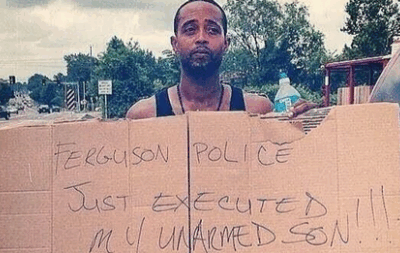
The tragic killing of college-bound teenager Michael Brown has raised questions about the frequency with which police kill unarmed black men in America. The answer, unfortunately, is far too often.
Just three months ago, on a warm April afternoon, a white police officer shot and killed Dontre Hamilton, a 31-year-old black man, in downtown Milwaukee's Red Arrow Park. According to the Milwaukee police chief, the officer was "defending himself in a violent situation." But the eyewitness report of a Starbucks barista paints a very different picture.
According to the barista, Hamilton had been sleeping on the concrete sidewalk next to Starbucks when two police officers approached him, asked him questions, and left after determining that he was doing nothing wrong. But an hour or so later, she heard yelling. Looking out the Starbucks window, she saw a different white police officer standing up against Hamilton, "who was holding the officer's own baton in a defense posture." The officer "lunged" at Hamilton in an attempt to get the baton, but failed.
By Guest Blog- ACLU National
The Beginning of the End for Marriage Discrimination in Florida
Prompted by the U.S. Supreme Court’s decision in the ACLU’s case on behalf of Edie Windsor that struck down the heart of the Defense of Marriage Act (DOMA), the law prohibiting the federal government from recognizing marriages of same-sex couples, more than 20 courts have issued rulings against similar state prohibitions.
Last week, Monroe County Circuit Court Judge Luis M. Garcia declared part of Florida’s ban unconstitutional. More cases are in the pipeline, including the ACLU’s case in federal court seeking what Judge Garcia’s opinion does not address: recognition of marriages performed in other states.

The Continued Push for LGBT Rights in the South and Beyond
This post originally appeared on the American Constitution Society blog.
By now it is cliché to observe that the advancements in equality for the lesbian, gay, bisexual, and transgender (LGBT) community in the past decade or so have been simply astounding. The victories have indeed been incredible, manifested not just in the securing of formal legal equality in some legislative and regulatory bodies but also dramatic shifts in public opinion and major wins in courts and administrative agencies (and, most recently, in President Obama’s announcement of a forthcoming executive order banning workplace discrimination against LGBT employees of federal contractors). This is something to celebrate.
But the fight is far from over, and complacency is not an option. The triumphs of the past few years have created a sense of inevitability that can serve as a useful advocacy tool but that may also blind us to the challenges that remain ahead.
To Fix Escambia County's Jail, We Have to Fix the System
This blog post originally appeared as an op-ed in the Pensacola News-Journal.
Oftentimes, it takes a tragedy to draw our attention to inadequacies and failures that have been long simmering just below the surface. And when the time comes to rebuild after a tragedy, if we lose the opportunity to also fix those long-festering problems, we do ourselves a disservice.
As we near two months since the tragedy at the Escambia County Jail that killed and injured inmates and staff, our community must take stock of our jail's controversial history and do what we can to change it.
Even before the lethal explosion, the jail was not where it should be.

Internal Police Emails Show Efforts to Hide Use of Cell Phone Tracking
As we suspected, local law enforcement officials are borrowing cell phone tracking devices known as “stingrays” from the U.S. Marshals Service—and police are deliberately concealing the use of stingrays in court documents submitted to judges in criminal investigations.
The ACLU of Florida released a set of internal police emails obtained today through a public records request with the subject line “Trap and Trace Confidentiality.” The documents confirm that local police, working on state court matters, hide behind the sham cloak of the U.S. Marshals’ office to keep the information about stingray use out of court files—and beyond even a court’s custody and reach.
Federal Court in Miami Rules on One of the Major Outstanding Constitutional Privacy Questions of Our Time
By Nate Freed Wessler, Staff Attorney, ACLU Speech, Privacy & Technology ProjectIn a tremendous step forward for our right to privacy under the Fourth Amendment, the Eleventh Circuit Court of Appeals has held in United States v. Quartavious Davis that police need a warrant to obtain historical cell phone location information from a cell service provider. The ACLU filed an amicus brief in the case, along with the ACLU of Florida, Electronic Frontier Foundation, Center for Democracy & Technology, and National Association of Criminal Defense Lawyers. In April, I argued the cell phone tracking issue before a three-judge panel of the court.This ruling is the first time a federal appeals court has held that the Fourth Amendment requires a warrant when police seek cell phone location records from carriers. As the court concluded: “In short, we hold that cell site location information is within the subscriber’s reasonable expectation of privacy. The obtaining of that data without a warrant is a Fourth Amendment violation.”
By Guest Blog- ACLU National

The DREAM's Alive and Well in Florida
By Maria Rodriguez, Executive Director, Florida Immigrant Coalition
Today's signing of a Florida law allowing young undocumented immigrants and U.S. citizen children of immigrant parents to pay the same tuition rate as every other Florida resident represents a truly remarkable achievement. It will change the lives of young immigrants like Carlos, who is twenty years old, undocumented, and comes from a family of agricultural workers.
By Guest Blog

Stay Informed
Sign up to be the first to hear about how to take action.
By completing this form, I agree to receive occasional emails per the terms of the ACLU’s privacy statement.
By completing this form, I agree to receive occasional emails per the terms of the ACLU’s privacy statement.