
Liberty and equality are everywhere under attack. And that’s why the work of the American Civil Liberties Union feels more precious to us than ever before. The ACLU lawyers and staff are the brave souls who suit up, blast off, and do what they can to divert and repel all those incoming meteors, or blow them right out of the sky. We admire them. We admire them the way you must admire people who devote themselves to doing, to the utmost of their ability, any thankless, impossible, and absolutely essential job.
Liberty and justice for all. We used to stand up with our classmates every morning and timelessly pledge liberty and justice for all, even and especially for those (as the Supreme Court, agreeing with the ACLU, ruled in West Virginia State Board of Education v. Barnette) whose consciences rebel at being compelled to pledge allegiance to a flag or to a country “under God.” The Bill of Rights protects pledgers and nonpledgers alike, but of course it is only the nonpledgers—the contrarians, the cranks, the nonconformists, the radicals and fanatics, the outsiders and the ostracized, the powerless and unpopular and imprisoned—who ever really need its protections. They also tend to be the ones least likely to receive those protections—not without a fight, anyway. That’s where the ACLU comes in.
The history of the ACLU is one of struggle, combat, of marginalized people and unpopular causes, of troublemakers and conscientious objectors, a history of battle and strife. But it is also the history of the very best our country has to offer to its citizens and, by way of example, to the rest of the world: the strong, golden strand of the Bill of Rights and the ideals it embodies, often frayed, occasionally snarled, stretched at times to the breaking point, but shining and unbroken down all the years since 1789. The ACLU holds the government, the courts, and the nation to their avowed and highest standard, insisting on the recognition of the protections the Constitution affords to every American, no matter how marginalized, no matter how unpopular the cause, even if the people it protects sometimes despise the freedom it represents.
As American Jews in our fifties, we both remember, powerfully, the moment we each first understood the austere and lonely fight of the ACLU, the thankless road to freedom on which it plies its trade. It was 1977, when the ACLU took on the case of the local branch of the American National Socialist Party, whose members wanted to hold a march along the main street of Skokie, a predominantly Jewish suburb outside Chicago. We remember wrestling with the difficult idea that the ACLU could be on the side of good (the First Amendment) and evil (Nazis) at the same time. To understand the vital role that the ACLU plays in American society requires a nuanced understanding of the absolute value of freedom of speech, freedom of assembly, freedom from unwarranted search and seizure, of the right to due process and equal justice under the law, even—again, especially—when those rights protect people we find abhorrent or speech that offends us.
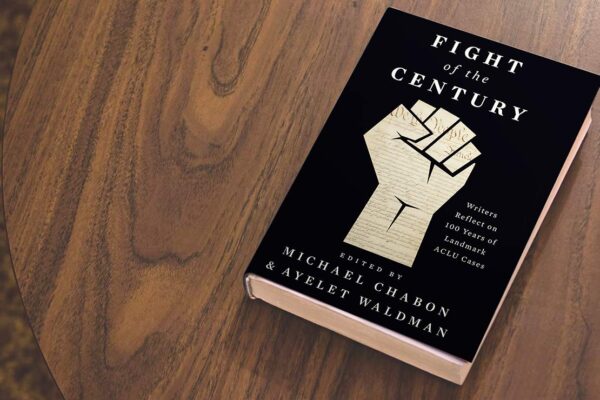
Nuance unfortunately seems to be in very short supply nowadays. In the pages of Fight of the Century: Writers Reflect on 100 Years of Landmark ACLU Cases, we have collected essays by some of our country’s finest writers (ranging from Marlon James and Ann Pachett to Elizabeth Strout and Viet Thanh Nguyen, and many more)—not just because writers are and have long been among the principal beneficiaries and guardians of the First Amendment but also because they traffic, by temperament and trade, in nuance and its elucidation, in ambiguity and shades of gray. We turn to writers, here and in general, to help us understand and, even more, grasp both ends of ambiguities, to expand the scope of our vision to encompass the whole gray spectrum of human existence, in all its messy human detail.
Enjoy.
Ayelet Waldman, Author,
& Michael Chabon, Author